
Design
 6 min read
Design Creating a Feedback Loop

The Black Hole
Emails, support cases, survey responses, phone calls, prospect notes, trade shows, onsite visits, pilot and beta programs. All of these touch points with our customers generate feedback, often great ideas to streamline and improve our product. Every product person dreams of having customers who are as invested in improving the product as they are. But when you have a large customer base with many different kinds of touch points, in comes a lot of feedback, hence the need in creating a feedback loop.
Feedback that is often siloed or disparate and difficult to unify. This is the Black Hole. Feedback comes in and the support team, the customer, the prospect has no clue if they were heard or if they are shouting their needs into a void. This can lead to a lot of over communication redundancy. Customer support submits feedback on behalf of a customer, they then need to follow up with the product team for status updates, and keep their own log of notes for when they follow up with their customers.
At Artera, we refuse to let that gap exist. We view feedback as mission critical. We can’t build an industry leading product without the collaboration of our experts and customers. This collaboration is what makes our products easy to use and ultimately successful.
Creating a Single Source of Truth
We needed a solution that could help us solve these operational challenges. We knew we didn’t have a collection problem; we had an organization problem. Our objective was clear: we needed to consolidate these disparate streams into a single source of truth that offered both context and automation.
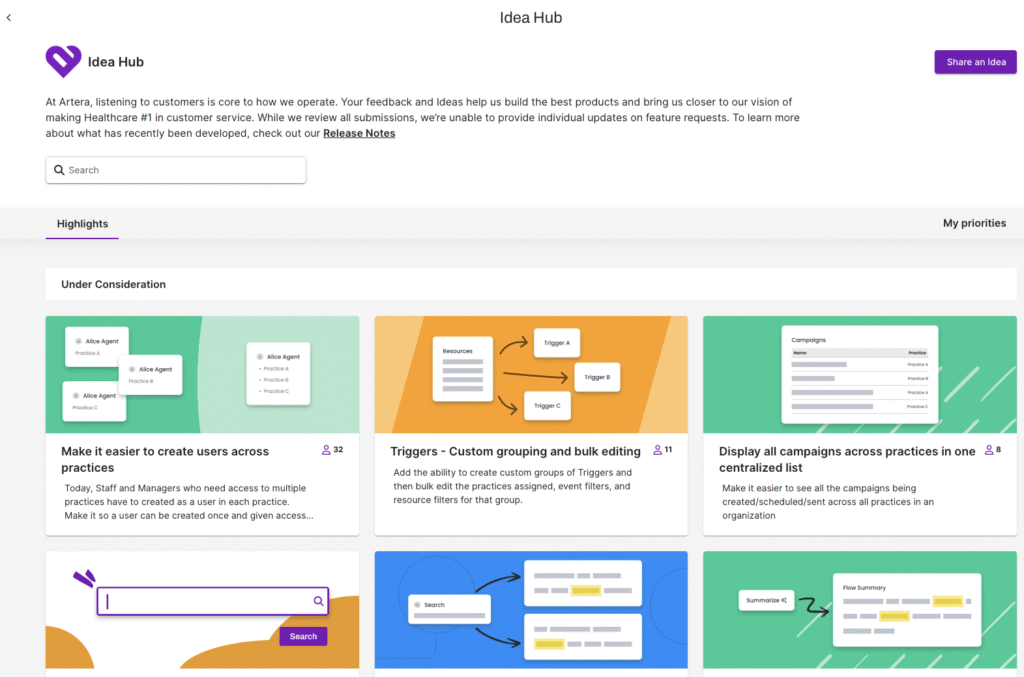
We chose Pendo Listen as our centralized repository. However, a tool is only as good as the workflow surrounding it to stay on top of the feedback coming in. We already had a clear product area taxonomy so we started by defining strict statuses for feedback to ensure data hygiene. We understand the importance of meeting customers and customer support where they are at and that by removing barriers to convenience we can facilitate more in the moment feedback. To meet that, we embedded a feedback form in Salesforce, where our customer support and sales folks spend the most time. And embedded the Idea Hub, the space where customers can submit feedback or vote on ideas directly in our existing Resource Center in Artera.
By placing the Idea Hub alongside our announcements and training modules, we created a unified hub to connect directly with Artera right in the flow of work. This placement was strategic; it allowed us to capture users at the moment of friction and leverage predictive search to show them existing requests before they even finished typing, reducing duplicate submissions.
The Feedback Loop
Showing all the ideas across our customer base evolved individual pain points into a collaborative effort. We unlocked a network effect of ideation. Now when a customer shares feedback they often find an idea from another customer that has shared a similar need. Instead of submitting a duplicate, they vote and comment on the existing idea. We are starting to see customers refining ideas with comments along the lines of “this would help a lot, but it needs to support X to be really impactful.” This helps our product team crowdsource early stages of product discovery as well as providing them with a curated list of customers who have said this is “must have” functionality.
We evolved our process from a feedback Black Hole to a unified Idea Hub, but this was more than a process improvement; it is a shift in how we engage with our customers. By consolidating feedback streams into a single source, we solved an operational problem and developed a more collaborative relationship with our customers and stakeholders.
Our commitment to feedback is mission-critical. It is the fuel for innovation, and by making it shared and collaborative, we ensure that the next great idea, the one that will continue to evolve our product and enhance the value we provide, is never lost.
Artera, a SaaS leader in digital health, transforms patient experience with AI-powered virtual agents (voice and text) for every step of the patient journey. Trusted by 1,000+ provider organizations — including specialty groups, FQHCs, large IDNs and federal agencies — engaging 100 million patients annually. Artera’s virtual agents support front desk staff to improve patient access including self-scheduling, intake, forms, billing and more. Whether augmenting a team or unleashing a fully autonomous digital workforce, Artera offers multiple virtual agent options to meet healthcare organizations where they are in their AI journey. Artera helps support 2B communications in 109 languages across voice, text and web. A decade of healthcare expertise, powered by AI.
Founded in 2015 and based in Santa Barbara, California, Artera has earned industry recognition for its rapid growth and workplace excellence. The company has been named a Deloitte Technology Fast 500 company for five consecutive years, ranked on the Inc. 5000 list of fastest-growing private companies for six years, and recognized as a BuiltIn Best Company to Work for six years in a row. Artera has also been honored by Forbes as one of “America’s Best Startup Employers,” featured in Newsweek’s “World’s Best Digital Health Companies,” and recognized by Business Insider as one of the top “44 Startups to Bet Your Career on in 2024.
For more information, visit www.artera.io.
Disclaimer: Artera’s blog posts and press releases are for informational purposes only and are not legal advice. Artera assumes no responsibility for the accuracy, completeness, or timeliness of blogs and non-legally required press releases. Claims for damages arising from decisions based on this release are expressly disclaimed, to the extent permitted by law.

Bridging the Analytics Gap: Why We Are Reimagining Our Client Data Experience
The Challenge: Embedded Analytics That Fall Short At Artera, we’ve consistently prioritized providing our clients with powerful data insights. Until…
Clarity Creates Confidence: Artera’s Categorical Data Visualization Color Palette
Choosing colors for your data visualization UI isn't just about making things look pretty—it's about ensuring accessibility and creating an experience that's as delightful as it is insightful.

Design Systems in Healthcare Tech Companies
In the landscape of healthcare technology companies, maintaining a consistent and unified experience is critical. By building a well-structured design system, Artera aims to do just that.